
UK CBAM for UK Importers
A practitioner's guide to the Carbon Border Adjustment Mechanism.
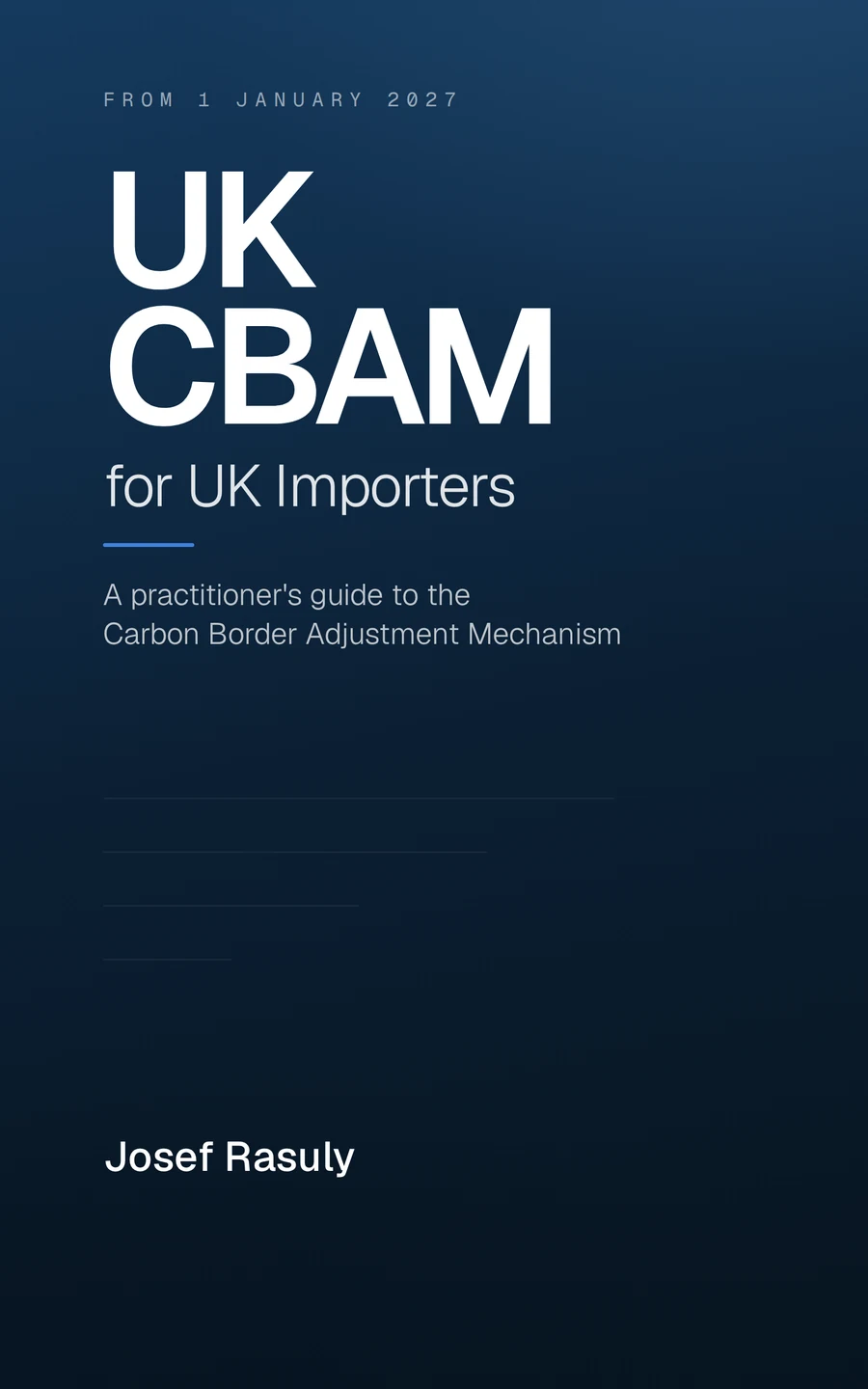
Kindle edition out now
On 1 January 2027 the United Kingdom starts charging UK CBAM, a tax on the emissions embodied in imported aluminium, cement, fertilisers, hydrogen, and iron and steel. The person who pays is the importer named on the customs declaration, and the amount turns on data held by a factory in another country that has never been asked for it. This is the book that takes a business from that position to a return it can defend.
Buy the Kindle edition on Amazon.co.uk
The Kindle edition was published on Amazon.co.uk on 16 September 2026. The paperback follows, and the newsletter carries one message when it is listed.
Product details on Amazon.co.uk
- Format
- Kindle Edition
- ASIN
- B0HK2BKVGN
- Publication date
- 16 Sept. 2026
- Language
- English
- File size
- 508 KB
- Screen Reader
- Supported
- Enhanced typesetting
- Enabled
- X-Ray
- Not Enabled
- Word Wise
- Enabled
- Print length
- 303 pages
- Page Flip
- Enabled
What UK CBAM is, read from the law that makes it
A practitioner's guide to the mechanism the Finance Act 2026 created, written for the people who have to act on it rather than for the people who debate it. It states the law as it stood on 13 September 2026, from the Act itself, the five statutory instruments made under it and the System Boundaries Document that two of those instruments incorporate. Every statement carries the provision it rests on, so a reader can check the book against the source rather than trust it.
Where a point still waits on a notice that HMRC has published only in draft, such as the UK CBAM default values, the book says so and says what a business should do in the meantime. That is the difference between a guide written from the instruments and a guide written from a summary of them: a summary cannot tell you which of its statements are settled.
Who the book is for
The finance director who has to accrue for a tax nobody has budgeted for. The customs manager whose commodity codes decide whether a consignment is caught at all. The procurement manager who has to extract a verified emissions figure from a mill that has never produced one. One part is written for that mill, so that it can be sent abroad and read by the supplier without any other part of the book.
What is inside, from the commodity codes to the first return
Twenty-eight chapters in nine parts, with five appendices. Part One says what has happened to you: which goods are caught, who the liable person is, what the tax is, and the dates that matter. Part Two works out the money: embodied emissions and the system boundary, the sectoral domestic price, default values against verified data, and a worked example that runs from a customs declaration to a figure. Part Three covers the UK CBAM registration threshold of £50,000, the return, payment, correction and records. Part Four is about getting data out of a supplier, and what to do when it does not come. Part Five covers the verifier. Part Six covers the goods outside the charge, carbon price relief and repayments. Part Seven covers penalties, assessments and appeals. Part Eight is the part for the producer outside the United Kingdom, with UK CBAM set against EU CBAM so that a supplier does not send the wrong report. Part Nine is the calendar of the first eighteen months, month by month, through the first return deadline and the two that follow it, with a note on each of the five sectors.
The appendices are the working parts: a glossary in the words of the instruments, the instruments themselves with their status and addresses, a document checklist for every consignment, a question sheet to send with a purchase order, and the UK CBAM commodity codes list from Schedule 16 in full.
How it is written
Every chapter opens on the reader's situation and answers one question. Every figure, date, section, schedule and regulation number was read in the instrument before it was written, and guidance is named as guidance rather than passed off as law. Every chapter ends with a check the reader can run against their own records that same afternoon. Nothing in the book sells a service, and the author does not file returns, does not classify goods and does not verify emissions data.
On this site
Much of what the book settles is answerable from this site. The commodity code checker says whether a code falls inside Schedule 16, the threshold calculator applies the £50,000 test, the guides answer the questions an importer asks first, and the updates record every change in the law as it happens. The book is the whole of it in one place, in order, with the working shown, and the errata page records the date to which its information was checked.
Kindle edition, 16 September 2026. Paperback to follow.